
- Home
- Services
- EV Charger Installation
Home EV Charger Installation in Southern NH & the MA Border
- Licensed MA & NH
- On-Site Master Electrician
- Fully Insured
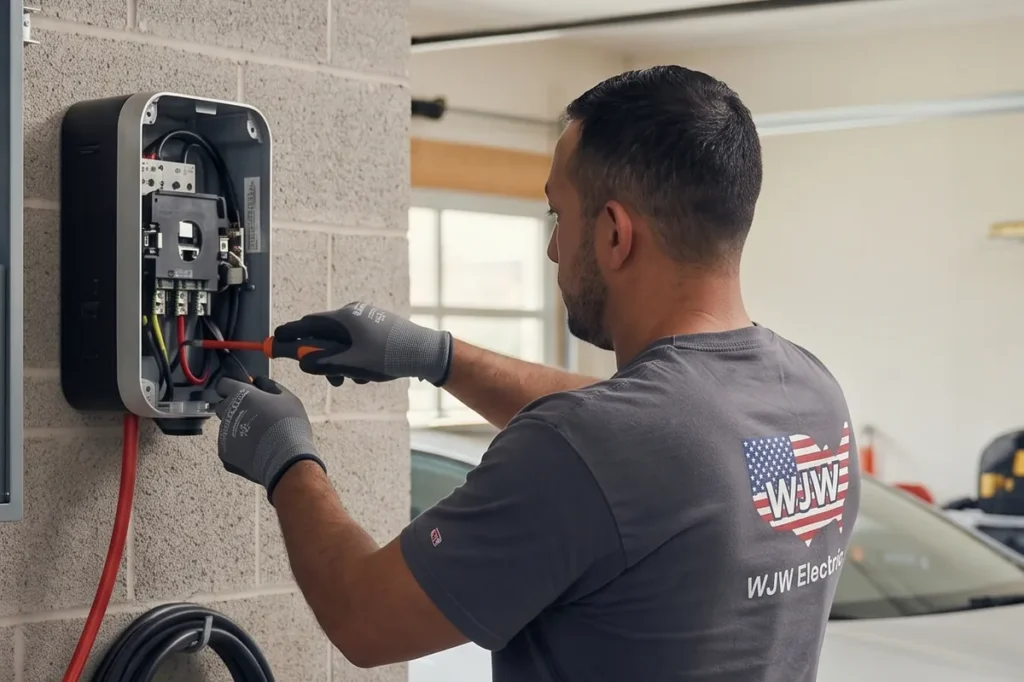
If you’ve gone electric — or you’re about to — the difference between loving the car and tolerating it usually comes down to home EV charger installation. Plugging into a standard wall outlet trickles a few miles of range an hour; a proper Level 2 charger fills the battery overnight. WJW Electric installs home charging for drivers across Southern New Hampshire and the Massachusetts border towns, sized correctly and inspected.
Billy Webber is a master electrician licensed in both Massachusetts and New Hampshire, based in Pepperell right on the state line. Every charger is installed by a master electrician on-site, on a dedicated circuit, with the load calculation done up front so nothing gets overloaded. Estimates are free and the price is explained before the work starts.
What Does a Home EV Charger Installation Involve?
Level 1 vs. Level 2 Charging
Every EV comes with a Level 1 cord that plugs into a regular 120-volt outlet. It works, but it’s slow — roughly 3 to 5 miles of range per hour, which can mean a day and a half to fully recharge. Fine for a plug-in hybrid or a very short commute, frustrating for anything more.
A Level 2 charger runs on 240 volts, the same kind of circuit as an electric dryer or range, and adds roughly 20 to 40 miles of range per hour depending on the charger and the car. For most households that means you plug in at night and never think about it again. That’s the install almost everyone actually wants.
Hardwired or Plug-In? Will Your Panel Handle It?
There are two ways to connect a Level 2 charger. A NEMA 14-50 outlet lets you plug in a portable unit and unplug it if you move or upgrade cars. A hardwired connection wires the charger straight to the circuit — often the better choice for higher-amperage chargers, outdoor installs, or a cleaner permanent look. We’ll walk you through which fits your charger and your garage.
The bigger question is capacity. A Level 2 charger is a large, continuous load, so the first step is a load calculation on your existing service. If your home is on 100-amp service or the panel is already full, you may need an electrical service upgrade before — or alongside — the charger. Because Billy does both, that’s one contractor and one coordinated job, not two.
What the Installation Looks Like
1
Free estimate & load calculation.
We look at your panel, your charger, and where you want it, then confirm your service can carry the load. You get a clear price.
2
Permit
EV charger circuits are permitted and inspected in both MA and NH. We handle the paperwork.
3
Installation.
We run the dedicated 240-volt circuit, set the correct breaker, and mount and connect the charger — hardwired or on an outlet.
4
Inspection.
The municipal inspector signs off on the new circuit.
5
Test with your car.
We confirm the charger powers up and charges before we leave, and clean up the work area.
Why Homeowners Trust WJW Electric With EV Charging
- Master Electrician, MA & NH — MA Lic. #23701-A, NH Lic. #16011. Licensed on both sides of the border.
- A master electrician on-site for the install — not an apprentice figuring it out.
- Fully insured, permitted, and inspected on every job.
- Unrestricted Construction Supervisor — CS-121037. Rare for an electrician; useful when a charger install involves structural or outdoor work.
- Load calculation up front so your panel is never quietly overloaded.
EV Charger Installation FAQs
Do I need a 240-volt outlet or a hardwired EV charger?
Both work. A NEMA 14-50 outlet lets you plug in a portable Level 2 charger and take it with you; a hardwired charger connects directly to the circuit and is often required for higher-amperage units or outdoor installs. We’ll recommend the right approach for your charger and location during the estimate.
Will my electrical panel handle an EV charger?
Often yes, but not always. A Level 2 charger adds a large continuous load, so we run a load calculation on your service first. Homes on 100-amp service or with a full panel sometimes need a service upgrade before the charger goes in — which we can do at the same time.
How long does EV charger installation take?
A straightforward install where the charger sits near the panel is usually a few hours. Longer conduit runs, outdoor routing, or a panel upgrade add time. You’ll get a clear timeline with the estimate.
Can you install a charger outdoors or in a detached garage?
Yes. Outdoor and detached-garage installs use weather-rated equipment and usually a hardwired connection, and a detached structure may need a trench or subpanel. It’s a common request and fully doable with the right materials.
Are there rebates for installing an EV charger?
Sometimes. Utility and state EV programs come and go and vary by town and provider, so it’s worth checking with your electric utility before you install. We can tell you what we’re seeing locally, but the current rebate details are best confirmed with your provider.