
- Home
- Services
- Generator Installation
Generator Installation in Southern NH & the MA Border
When a nor’easter takes the power out for three days, the difference between an inconvenience and a disaster is a generator that starts on its own. WJW Electric installs standby and portable generator systems, permitted and inspected.
- Licensed MA & NH
- On-Site Master Electrician
- Fully Insured
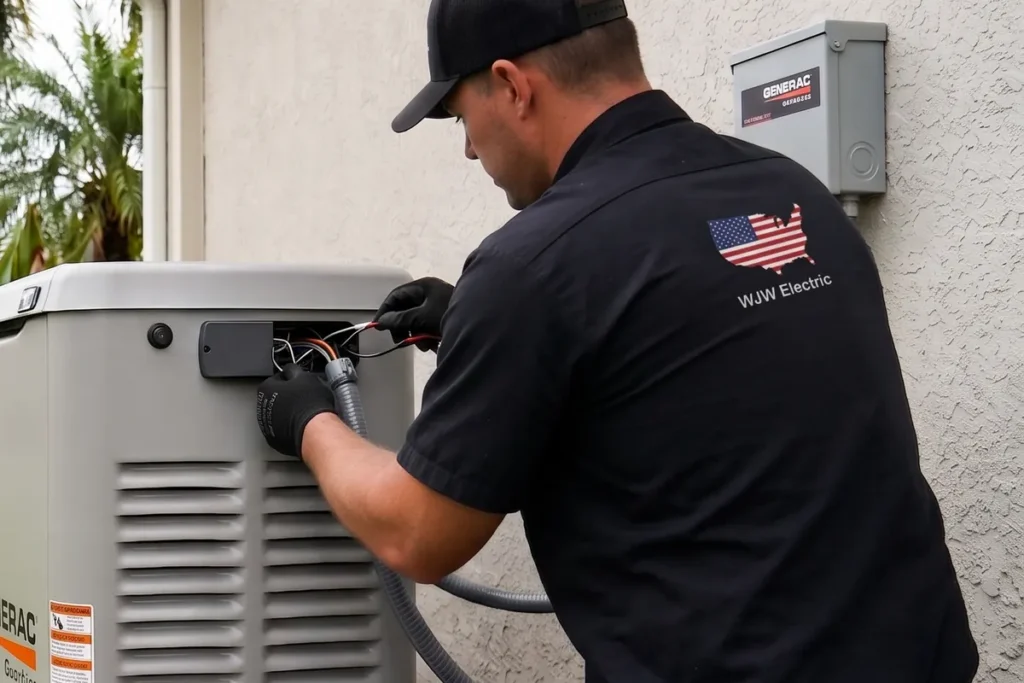
Anyone who has been through a New England ice storm knows how fast a house gets cold, and how quickly a well pump and a sump pump go from background appliances to urgent problems. Generator installation is one of the most common calls WJW Electric gets across Southern New Hampshire and the Massachusetts border towns — usually right after an outage, and ideally well before the next one.
Billy Webber is a master electrician licensed in both Massachusetts and New Hampshire, working out of Pepperell right on the state line. Whether it’s a whole-home standby unit or a proper hookup for a portable generator you already own, the electrical side is done by a master electrician on-site, permitted and inspected. Free estimates, and an honest read on what you actually need to keep running.
What Does Generator Installation Involve?
The transfer switch is the part that matters most, and the part homeowners tend not to know about. It’s what stops your generator from pushing power back onto the utility lines — which is a genuine danger to the crews out working to restore your service. It’s also what lets the changeover happen safely rather than by running cords through a window.
Standby or Portable? Which Fits Your Home
A standby generator is installed permanently outside the house on a pad, runs on natural gas or propane, and starts itself within seconds of an outage — whether you’re home or not. That last part is the real value. If you travel, if you have a sump pump holding back a wet basement, or if anyone in the house depends on powered medical equipment, a system that doesn’t need you present is worth what it costs.
A portable generator is far less expensive and perfectly reasonable if you’re home during storms and don’t mind rolling it out. But it still needs a proper hookup: a manual transfer switch and an exterior inlet, so you plug in one cord outside instead of running extension cords through a door. Plenty of homeowners already own the generator and just need it connected safely — that’s a common and much smaller job.
We’ll walk through both honestly. Not everyone needs a standby unit, and we’ll say so.
Sizing: What Actually Needs to Stay On
The instinct is to power everything. The better question is what genuinely matters at 2am in February. For most homes in these towns, the essential list looks like heat, the well pump, the refrigerator, the sump pump, and enough lighting and outlets to live normally.
Larger standby units can carry a whole house comfortably. Smaller units are sized to essential circuits, which keeps the cost down considerably. Either way it starts with a load calculation, not a guess — and if your panel is already full or the home is on 100-amp service, an electrical service upgrade may be part of the picture. Better to know that at the estimate.
Whole-House Surge Protection
Worth pairing with a generator, and often overlooked. Surges don’t only come from lightning — they also come from the grid itself, including the moment power is restored after an outage. That restoration spike is exactly when sensitive electronics tend to die.
A whole-house surge protector installs at the panel and clamps those spikes before they reach your equipment. It protects the things that are expensive and annoying to replace: heat pump and furnace controls, appliance boards, computers, and increasingly the smart devices running throughout a modern home. It’s a small addition alongside generator or panel work.
What the Installation Looks Like
1
Free estimate & load calculation.
We talk through what needs to stay on, look at your panel, and confirm whether standby or portable fits your situation.
2
Sizing and placement.
The generator is sized to the load and sited correctly — clearances, exhaust, and distance from windows all matter.
3
Permit.
Generator and transfer switch work is permitted and inspected in both MA and NH. We handle the electrical permit and coordinate the inspection.
4
Transfer switch and wiring.
The transfer switch is installed and wired to your panel — automatic for standby, manual with an exterior inlet for portable.
5
Generator connection.
The unit is connected and, for gas-fired standby units, coordinated with the fuel hookup.
6
Test, inspect, and walk through.
We simulate an outage so you see it work, the inspector signs off, and you get shown exactly what to do when the power actually goes.
Why Homeowners Trust WJW Electric With Generators
- Master Electrician, MA & NH — MA Lic. #23701-A, NH Lic. #16011. Licensed on both sides of the border.
- Transfer switches done right — no backfeed risk to utility crews, no cords through a window.
- Honest sizing — essential circuits when that’s enough, whole-house when it’s warranted.
- Unrestricted Construction Supervisor — CS-121037. Useful when a standby install involves a pad, clearances, or structural work.
- A master electrician on-site for the work, not an apprentice figuring it out.
- Permitted, inspected, and tested before we leave.
Generator Installation FAQs
Do I need a transfer switch for a generator?
Yes. A transfer switch is what safely separates your home from the utility grid while the generator runs. Without one, power can backfeed onto utility lines and endanger the crews restoring service. Running a generator through an extension cord into an outlet is both unsafe and illegal — a proper transfer switch is required on any permanent installation.
What’s the difference between a standby and a portable generator?
A standby generator is permanently installed outside, runs on natural gas or propane, and starts automatically within seconds of an outage. A portable runs on gasoline, gets rolled out when needed, and connects through a manual transfer switch and exterior inlet. Standby costs more up front but asks nothing of you during the outage.
Can a generator power my whole house?
It depends on the size of the unit and your electrical service. Larger standby generators can carry an entire home; smaller units are sized to essential circuits — heat, well pump, refrigerator, sump pump, and some lighting. We run a load calculation and help you decide what genuinely needs to stay on.
Does generator installation require a permit?
Yes. Generator and transfer switch installations require an electrical permit and inspection in both Massachusetts and New Hampshire, and gas-fired standby units also involve the fuel connection. We pull the electrical permit and coordinate the inspection.
How long does it take to install a standby generator?
The electrical work is often one to two days once the equipment and pad are ready. The full timeline is usually longer — equipment lead time, the gas or propane connection, permitting, and the inspection — so planning a few weeks ahead is realistic. Calling before storm season beats calling during it.
Do generators need maintenance?
Yes. Standby units self-test on a schedule and need periodic oil, filter, and battery service per the manufacturer, much like any small engine. The most common reason a generator fails during an outage is that it sat for years without being serviced or tested.